
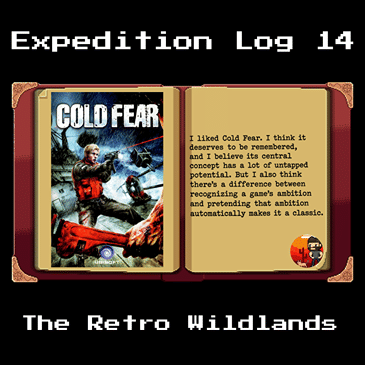
A forgotten survival-horror game lost at sea… but does it deserve to be rescued?
On this episode of The Retro Wildlands, we're boarding a storm-tossed Russian whaling vessel in Cold Fear, a chilling survival-horror adventure where the storm isn't the only thing trying to kill you! With a ship that's constantly fighting against you, grotesque creatures lurking around every corner, and a mystery waiting to be uncovered, Cold Fear has all the ingredients for a memorable horror experience. But beneath its ambitious ideas lies a game that may have just as many problems as it does strengths.
Is this an overlooked survival-horror gem, or a promising experiment that never quite reached its destination? Grab your life jacket and join the expedition. We're heading into some very cold waters with this one.
Intro - 0:00
Setting Out on the Expedition - 4:20
Surviving the Game vs. Fighting the Controls - 15:56
Lost at Sea - 26:55
A Mystery Without Payoff - 32:31
Journey’s End... Is Cold Fear Underrated? - 41:21
Closing Gratitude - 47:45
Check out our website!
https://theretrowildlands.com/
The Retro Wildlands is part of the SuperPod Network of gaming podcasts and content! Check us out!
https://superpodnetwork.com/
Join the SuperPod Lounge Discord Server!
https://discord.com/invite/7zXbMvVQks
Follow the Retro Wildlands on Social Media!
Linktree: https://linktr.ee/retrowildlands
Check out the Retro Wildlands on YouTube!
https://www.youtube.com/@retrowildlands
[00:00:13] Greetings fellow travelers, vagrants, explorers, wildlanders, and welcome to the Retro Wildlands. My name is Nomad and this is my gaming podcast where I like to share my thoughts and experiences with a video game that I've discovered or rediscovered while roaming the gaming wildlands. Thank you for joining us around the campfire my friends. Today we're setting out on another
[00:00:38] expedition but this time we're trading the familiar trails of the wilderness for something a little colder, a little darker, and considerably wetter. Life jackets and flashlights are a must on this adventure so make sure your gear is in tip-top shape. Veteran listeners of the show probably know my love for old school survival horror games. I was practically raised on Resident Evil after all, so it may come as
[00:01:04] a surprise to some of you that I inadvertently left a lot of good survival horror games on the table when the PlayStation 2 launched. The PS2 is a console that needs no introduction, but one of the reasons it's one of my favorite is because it was the home of some amazing horror games back in the day. One such game that I didn't even learn about until a few years ago was a little game called Cold Fear.
[00:01:31] A third-person over-the-shoulder experience, Cold Fear was released a couple months after Resident Evil 4, a game that took Resident Evil and arguably survival horror itself in a new direction. I'm sure most of us know how popular RE4 was. It's practically a household name at this point, and it's a game that would go on to cast a very long shadow over the third-person horror and action
[00:01:57] game scene. The genre itself was evolving, and third-person action games were finding new ways to balance shooting, exploration, and horror. Since Cold Fear came out so close to RE4 and shared some gameplay similarities, it was hard for people not to compare the experiences. I think that comparison is worth discussing, but I also think it can be a little unfair. Yes, these games share some similarities,
[00:02:26] particularly in their approach to third-person shooting, but Cold Fear has an identity of its own and its ship-based setting gives it a gameplay hook that I honestly can't think of many other games matching in quite the same way. That's where my journey with Cold Fear gets interesting. Because the more time I spent with it, the more I appreciated what the developers were trying to
[00:02:50] accomplish. The atmosphere could be excellent, the setting was memorable, the environmental effects were impressive, and the idea of fighting for your life aboard a ship that's constantly pitching and rolling had the potential to create some genuinely tense encounters. But I also ran into some frustrations that repeatedly pulled me out of the experience. There were moments when I was completely absorbed in the
[00:03:18] world, followed by others when I was fighting the controls, wandering around trying to figure out where the hell I was supposed to go, or wondering why certain parts of the game felt so much less polished than the ideas behind them. By the time I reached the end of the game, I found myself with some pretty mixed feelings. Overall, I liked Cold Fear. I think it deserves to be remembered, and I believe
[00:03:44] its central concept has a lot of untapped potential. But I also think there's a difference between recognizing a game's ambition and pretending that ambition automatically makes it a classic. So today, we're going to explore both sides of that equation. We'll talk about what makes Cold Fear such a memorable survival horror experience, where its rough edges begin to undermine it, and why I think
[00:04:12] this is one of those games that could benefit enormously from a modern reimagining. Wildlands Expedition Entry 14 Cold Fear PlayStation 2
[00:04:39] Originally completed October 22, 2026
[00:06:02] PlayStation 2 is the best-selling video game console of all time, and for how the system's gaming library was so robust, I tend to think about spooky video games when I think about the system. Wildlands There's so many special horror games that came out on the system, and a lot of them are pretty rare if you're looking for them for your collection. I'm talking about games like Silent Hill 2, 3, and 4,
[00:06:30] Haunting Ground, Fatal Frames 1, 2, and 3, Rule of Rose, Kuon… Wildlands But amidst all of these, there was one game that slipped into the middle of all of these games, and when I first heard about it, I knew I had to try it. One of the first things that struck me about Cold Fear was just how well it establishes its atmosphere.
[00:06:58] Before we get too far into things like the combat, the story, or the various creatures waiting to tear us apart, the game does a great job of making us feel like we've found ourselves somewhere we absolutely do not want to be. The premise of this game is pretty straightforward. We're not exploring some abandoned mansion or wandering through a quiet little town where something has gone horrifically wrong.
[00:07:22] We are stepping into a situation unfolding in the middle of a violent storm aboard a Russian whaling vessel where the crew has seemingly met a terrible fate. Our protagonist, Tom Hansen, is a Coast Guard officer who gets caught up in the investigation after a distress call draws attention to the ship. What should be a rescue operation quickly turns into something much more sinister.
[00:07:50] The whaling vessel is crawling with hostile, infected crew members, and the situation is clearly out of control. And the deeper Hansen gets into the mystery, the more apparent it becomes that this is no ordinary maritime emergency. And the funny thing is, Tom just happens to get involved because he just happened to be on a ship closest to the Russian vessel at the time. Talk about wrong place, wrong time.
[00:08:18] There's a very effective simplicity to that setup. A ship in distress is already an unsettling place to be. Add a storm that threatens to throw you into the freezing ocean, a crew that's either missing or dead, and a collection of things that are very much not supposed to be moving the way that they are, and you have the ingredients for a pretty compelling survival horror adventure.
[00:08:43] And I think the developers of this game understood something very important here. The setting doesn't need to be complicated to be frightening. It just needs to make sure that you feel trapped. Think about it. When you're aboard a ship in the middle of a storm, you can't simply walk outside and head for the nearest town. You're surrounded by water miles away from safety, and the very thing keeping you
[00:09:10] afloat has become part of the danger. Every corridor leads somewhere deeper into this nightmare, and every door you open could reveal yet another threat. There's a natural sense of isolation baked into the premise, and cold fear makes good use of it. While you play as Tom Hansen, the ship itself is the real star of the show.
[00:09:35] The developers didn't treat it as a static backdrop for the action. The vessel is constantly moving, rocking back and forth as the waves batter it from every direction. When you're out on deck, you can feel the instability in the way your character moves and tries to stay upright. The ship can tilt far enough to throw you off balance, and suddenly something as simple as walking from one end of the deck to the other becomes a little adventure of its own.
[00:10:04] The ship can actually become annoying at times. There were definitely moments when I wanted to get from point A to point B, and the ship had other ideas. But at the same time, it's difficult to criticize the game for trying to make the environment feel physically believable. I mean, you're on a vessel being tossed around in a raging storm, you should have trouble keeping your footing. But it's much more
[00:10:31] than that, though. It isn't just an animation playing in the background while we go about our business. The movement of the ship affects the actual gameplay. When you're trying to aim a weapon, the shifting deck can make it difficult to line up a shot. You have to account for the environment around you rather than treating every encounter like you're standing on a perfectly level shooting range. The game even gives you ways to steady yourself when aiming, which helps reinforce the idea that you're
[00:11:00] a person trying to main control in a very unstable environment. It's a clever concept, and it feels appropriate to the world the developers have created. The storm isn't just there to look dramatic, it's something you have to physically contend with. Visually speaking, I think Cold Fear does a pretty impressive job of selling the experience. For a game released in 2005, there are some genuinely
[00:11:27] good-looking environments here. The ship has a grimy industrial appearance that makes it feel like it's a working vessel rather than a collection of rooms built specifically for a video game. The character models hold up reasonably well, and there are areas where the environmental detail really stands out. The lighting is another highlight. Dark corridors, dimly illuminated rooms, and the glow of lights
[00:11:55] against the surrounding darkness help establish a sense of unease. Cold Fear also uses real-time lighting effects, including lights attached to your weapons, which can make exploring some of these spaces feel pretty atmospheric. Sometimes the lights may go out completely, and a light on the end of your handgun may be the only thing that you have to see your way forward.
[00:12:20] And then there's the weather itself. Watching the water crash over the deck, seeing the waves batter the ship, and observing the spray and other environmental effects all help sell the idea that this vessel is fighting for its life just as much as you are. These details might not seem particularly remarkable by modern standards, but they contribute a great deal to the experience, especially when you
[00:12:46] consider the hardware this game was running on at the time. Of course, the atmosphere isn't entirely dependent on the storm. Once you start exploring the ship's interior, the game begins trading the wide open view of the ocean for cramped hallways, shadowy rooms, and unsettling discoveries. The contrast works pretty well, I'd say. Out on deck, you're exposed to the elements fighting to keep
[00:13:12] your footing, but inside, you're surrounded by tight spaces where you can't always see what's waiting around the next corner. Neither environment feels particularly safe, and that's exactly what you want from a survival horror game. You want the location itself to contribute to your discomfort. You want to feel like you're somewhere you shouldn't be, somewhere that has become hostile, somewhere
[00:13:38] that offers very little places to hide. This entire presentation and setup grabbed my attention immediately, and as I spent more time aboard the vessel, I found myself increasingly impressed by the atmosphere and the ambition behind it. But there's a catch. An environment can be frightening because it makes the player feel vulnerable. It can also become frustrating when the mechanics make it difficult
[00:14:06] to control the character. And, unfortunately, cold fear sometimes walks a very fine line between those two things. Now, the rocking ship is a brilliant idea. The way it affects your movement and your aim makes sense within the world. But when you combine that instability with a camera and control scheme that can feel very awkward, the experience can become a little less thrilling than intended. We'll get into some of
[00:14:35] those issues shortly, but for now though, I want to give cold fear credit where it's due. The developers had a genuinely interesting idea and they built an entire survival horror experience around it. The storm, the ship, the lighting, the water, and the cramped interior spaces all work together to create a setting that feels distinct from the abandoned towns and sprawling mansions that we often associate with the genre.
[00:15:03] And that is why I found myself wanting to like this game so much. It's a terrific foundation for a survival horror game. The question, though, is whether the rest of the experience can live up to it. Stravudia? Speak English. It doesn't matter now. What's going on here, Colonel? A terrible mistake. Find Anna. She has answers.
[00:15:31] Where is she? Locked up for protection. After that idiot Captain Lubensky hid in the cold storage. Now here, take this experimental. The bolts are chemically treated to distract them. It may save your life.
[00:16:07] So we've established that cold fear has a fantastic setting, a memorable premise, and an environmental mechanic that gives it a personality of its own. But there's one problem that kept getting in the way of my enjoyment, and it's something that becomes increasingly difficult to ignore the longer you play. That being the controls. Now, I don't want to make it sound like cold fear is completely unplayable or anything. It certainly isn't. I was able to work my way
[00:16:36] through the game, and I eventually found myself having a very good time with the movement and the combat. But there were so many moments when I felt like I was wrestling with the controls instead of fighting the horrors in front of me. For context, let's start with the camera. During normal movement, the camera follows Hansen around, and you can't simply use the right analog stick to rotate the
[00:17:00] camera and look around at the environment. You have to work with the perspective that the game gives you. When you aim your weapon, you gain more freedom to look around, and clicking the right thumbstick down allows you to enter in aiming mode without having to keep a shoulder button held down. On paper, that sounds manageable enough, and once you get used to the system, you can make it work for you.
[00:17:25] But in practice, it can feel clunky, particularly when you're moving through cramped spaces or trying to deal with enemies that aren't positioned directly in front of you. The camera doesn't always give you the information you need, and moving Hansen around can feel stiff and awkward. That becomes especially frustrating when you consider the environment that we had just talked about. The ship is already rocking
[00:17:49] beneath your feet, making it harder to move and aim. That's supposed to create tension, and I think it does, but when the camera and controls are also working against you, it becomes difficult to tell where the challenge ends and the frustration begins. Oh, and those cramped spaces? Forget about it. Trying to maneuver around enemies or simply fighting them in tight corridors can be an exercise in
[00:18:15] patience. You're trying to keep your distance, line up a shot, and avoid taking damage, all while dealing with a character who doesn't always move as smoothly as you like. It's a shame because the combat has some genuinely enjoyable elements here. Once I started getting comfortable with the aiming system, which has you holding down the left shoulder button to aim and pressing the right shoulder button to fire,
[00:18:40] I found myself having more fun with the shooting than I thought I was going to. There is something very satisfying about lining up a precise headshot, dropping an enemy before it can get too close, and then turning your attention to the next threat. When you get into a rhythm, combat can feel pretty good. You can also use melee attacks when enemies close the distance, which gives you another option when shooting isn't
[00:19:05] practical. And taking down groups of enemies with well-placed shots can be very satisfying, especially when you manage to keep your cool in a situation that initially looks like it could go very badly. The problem is that the game doesn't always make these encounters feel as reliable as they should. Hit detection can be a little wonky, and I had moments where enemies' melee attacks seemed to connect
[00:19:30] with my character from a distance that looked a little too far away. Other times, I'd take damage from an enemy that was outside my immediate field of view, and I wouldn't be entirely sure where the attack came from until it was much too late. And that brings me to the enemy of the enemies themselves. One thing I appreciated is how important headshots can be. This was the first
[00:19:54] zombie game I personally played where I felt like destroying the enemy's head was such a central part of dealing with the threat. And I don't mean I occasionally aimed for the head because I knew it was going to do more damage. I mean, I started treating every suspicious corpse as a potential problem. Without getting too deep into the story reasons, you find out early that the infected will only truly
[00:20:19] die if the brain is destroyed. Other video games with zombies and zombie-like creatures have adopted that philosophy, but none of them have put it into practice quite like Cold Fear has. Pumping your enemy full of bullets in Cold Fear may knock your attacker down, but they will always get back up unless you destroy their heads. I found myself shooting the heads off bodies lying around because I didn't want to take any chances.
[00:20:47] As I was going through the game, my thought was, well, if I'm dealing with a zombie outbreak and destroying the head is truly the only way to keep those things off of me, I figured I better make sure those things stay down. And I love how the game made me think this way without explicitly telling me to do this. I'm not sure if I'm going to do this. Did shooting the heads off random dead bodies actually help me in the long run? I have no idea, but I'd like to think so.
[00:21:14] Now, the enemy that you're fighting, though, is a little bit more complicated than that. The game has its own terminology for the creatures you encounter, and some of them have a nasty surprise waiting for you. The exocells, as they're called, can emerge from enemies after you've successfully decapitated them. So even when you think you've dealt with a threat, you may still need to keep your eyes open.
[00:21:40] I like that. It gives you a reason to remain cautious and reinforces the idea that the infection ravaging the ship is something you don't fully understand. You can't always assume that a seemingly successful kill means that the danger has passed. One thing the game does, though, that's a little less immersive is the game will have enemies reappear in areas that you've already cleared.
[00:22:07] Rather than making me feel like I was being hunted by this exocell threat, having enemies reappear in areas that I've already cleared out actually became more of an annoyance than I thought it would be. I'd revisit a location that I thought was safe, discover another group of enemies, and have to deal with them all over again. I've always liked the idea of using my limited resources strategically to
[00:22:32] slowly win over the area. The idea of reoccurring enemies overall might have worked better if ammunition were genuinely scarce, I will say. During my playtime through Cold Fear, the game was fairly generous with supplies since we're on the topic. Despite the survival horror setup suggesting that every bullet should count, I really felt as though I was constantly on the brink of running out. That said,
[00:22:59] the returning enemies often felt less like a frightening reminder that nowhere was safe and more like an inconvenience slowing down my progress. Since we're on that topic, there were some other design decisions that fall into that same category. Cold Fear doesn't use a traditional inventory system where you collect medical supplies and decide when to use them. Ammunition is capped for each weapon,
[00:23:26] and medkits are used automatically when you pick them up. Now, I understand the appeal of simplifying things. It keeps the action moving forward, and it means that you don't have to spend time opening menus to manage every little resource that you have in your pocket. But I missed having an inventory to manage, and I certainly missed having the option to save a medkit for later when I thought I really needed it.
[00:23:52] Picking up a medkit and having it automatically restore your health on the spot might be convenient, but it removes a little of that survival horror decision making that I enjoy. Picking up a medkit and having it to be a little bit more difficult to save. I'm not sure if I'm going to be able to save my progress throughout your adventure is another thing that I felt was a mixed bag experience. Cold Fear uses checkpoints rather than allowing you to save whenever you want. I'll admit there's something effective about realizing it's been a minute since
[00:24:21] your last checkpoint and suddenly becoming much more careful about what you do on your adventure. You start thinking about the next objective and hoping that you make it there before something goes horrifically wrong. That can create some genuine tension, but it can also be inconvenient when real life interrupts your expedition and you need to stop playing unexpectedly. I don't mind checkpoint-based saving in principle, but there were times when I would have appreciated a little bit more flexibility.
[00:24:52] I feel like I've been dancing around a bit when it comes to Cold Fear's gameplay, but overall there are ideas here that I genuinely like. The headshot mechanics, the threat posed by the exocels, the challenge of fighting on a moving ship, and the satisfaction of lining up accurate headshots all give the combat some personality. The longer I played, the more I found myself enjoying those moments when everything clicked.
[00:25:19] But too often, that enjoyment was interrupted by awkward movement, frustrating camera behavior, inconsistent hit detection, or encounters that felt more irritating than frustrating. I could see the game I wanted Cold Fear to be. I could see how its systems might work together to create something special. But I was also constantly aware of the things getting in the way, and that's a
[00:25:47] frustrating place for a survival horror game to leave you. The whole point is to make you feel like you're struggling to survive the nightmare. You shouldn't also have to struggle quite so much to make the game do what you want.
[00:27:04] Now, I'm no stranger to getting lost in a survival horror game. I don't mean lost in the experience, I mean actually lost having absolutely no idea where I need to go. Sometimes that is part of the fun. You're exploring unfamiliar territory, piecing together clues, and trying to figure out where the game wants you to go next. But there's a difference between being lost in a horror game and feeling like the
[00:27:31] game has misplaced you, and I felt like Cold Fear occasionally struggles to understand that balance. One of my biggest frustrations was the lack of an in-game map. I couldn't pull up a layout of the ship to see where I was or which areas I had already explored. Now, I understand the argument for this from a realism standpoint. We're investigating an unfamiliar vessel in the middle of a disaster
[00:27:58] situation. We wouldn't necessarily have a convenient map of every corridor and room handy. To give the game some credit though, it does provide a way to read signs around the ship by aiming your weapon at them. Since many of these signs are written in Russian, this little mechanic can help you identify where you are and navigate the vessel this way. It's a neat little touch, but it doesn't
[00:28:23] solve the bigger problem that I had. Mission objectives can also be a bit vague, and there were stretches where I found myself wandering back and forth between rooms revisiting places that I'd already explored because I could not figure out where the next path had opened up. This became particularly frustrating when I took a break from playing and then returned maybe days later only to find myself struggling to remember where I needed to go and where I had already gone.
[00:28:52] I had occasionally wondered if this was a deliberate attempt to maybe pad out the game's runtime, but I can't say that that was the developer's intention. What I can say is that it sometimes made the experience feel longer without making it feel more enjoyable. Now, from my perspective, this is where I think Cold Fear misses an important part of what makes exploration work in survival horror. Let's take Silent Hill for example.
[00:29:22] I can get lost wandering the streets of Silent Hill, unsure which direction I should be heading or what I'm supposed to find. I mean, who wouldn't? The town is literally covered in fog. But even when I am not making progress in Silent Hill, I still feel uneasy. And to be clear, it's not just the fog doing this here. It's the constant sense of danger, and the overall atmosphere
[00:29:49] makes me reluctant to explore certain places even though I know I need to. In that way, being lost is the most part of the horror. With Cold Fear, however, I sometimes found myself so focused on finding the next route that I stopped feeling frightened altogether. I wasn't worried about what might be lurking around the next corner. I was just genuinely annoyed that I had already checked
[00:30:16] this room three times and I still couldn't figure out where the hell to go, and then, oh, I guess there's enemies in this room that I have to take down for the fourth time. I think you get the idea. Ultimately though, I don't need a game to hold my hand. I do enjoy figuring things out for myself, and I'm perfectly happy to spend time exploring when there's a good reason to do so.
[00:30:40] But being lost is only frightening when the game gives you a reason to fear what might happen while you're lost. That's what I wanted more of from Cold Fear. Give me a dark corridor I'm reluctant to enter. Give me the sound of something moving somewhere that I can't see. Make me wonder whether
[00:31:04] I should risk exploring just one more room with the limited ammunition that I have left. Don't make me spend ten minutes wandering around because I missed an obscure route. And the frustrating thing is, Cold Fear has almost everything it needs to make that kind of exploration work. The ship is an excellent setting for it. Those narrow corridors, dark rooms, and unfamiliar surroundings should make
[00:31:34] every wrong turn feel dangerous, but instead the navigation sometimes gets in the way of the atmosphere. And that is a real shame because when the game gets that balance right, it reminds you just how effective this setting can really be. Who are you? What are you doing here? Tom Hansen, my name is Tom Hansen, I'm a friend. Why should I believe you? Tom Hansen, because I'm here and you're not dead.
[00:32:03] Ha, funny. Where is Dimitri? Yusupov's dead. Good. The pastor deserved it. So can you tell me what the hell is going on here? He said you had some answers. He lied. I don't have answers. Then who does? Papa does. We can radio him. He will know what to do. I think you and I are linked, Hansen. We will both make it through this, or neither of us will. I vote for both. I don't think you have a choice.
[00:32:40] For all of the frustrations I've had up to this point with playing Cold Fear, I want to make something clear. I was fairly interested in the story. As I was moving my way through the corridors of the ship, I really wanted to know what had happened aboard this vessel, what was responsible for the nightmare unfolding around me, and how everything connected. We've got a mysterious infection, a vessel full of horrifying creatures,
[00:33:08] and a Coast Guard officer who finds himself caught up in something far beyond an ordinary rescue mission. There's plenty of potential here, and I was curious to see where the game would take me. The trouble is, a LOT of this game's story is delivered through documents, journals, and notes scattered throughout the environment. Now, I am NOT opposed to this approach. Some of my favorite
[00:33:32] horror games often use written documents to fill in the gaps, offering little glimpses into the lives of the people who were there before the player arrived. Heh, I'm looking at you, Keeper's Diary from the original Resident Evil. When done well, these discoveries through documentation and written sources can be incredibly effective. It can make the world feel lived in and it allows the player to
[00:33:59] piece things together at their own pace. But there is a balance to strike, and I don't think Cold Fear always gets it right. When it comes to the meat of these story-riddled documents, a lot of them are long. I'm talking about journal entries that can take several minutes to read. And while I wanted to understand the story, stopping in the middle of a survival horror adventure to read what feels like
[00:34:27] an entire chapter of a novel had a way of interrupting the pacing for me. It also wasn't easy for me to keep the names of different characters straight or remember how all the different details fit together. I could be wrong, but when I count up the actual characters that I physically run into versus the number of characters that I read about, I think the number of characters that I read about and never
[00:34:52] met were probably double the actual physical characters that were in the game itself. There were some interesting pieces of information in these documents that you find, but the way that they were presented sometimes made it difficult to maintain a clear picture of the bigger story. And that is unfortunate, because the story itself had some interesting ideas. I just wish more of that information had been delivered in ways that kept me connected to what was actually happening in the
[00:35:20] moment. Thankfully, the atmosphere occasionally steps in and reminds you what this game is capable of. One location that stood out to me was a very long hallway filled with corpses that were hanging upside down from chains. The bodies sway as you move through the space, the chains rattle, and the ominous soundtrack adds to the feeling that you've stumbled into some place that is truly horrible. It's a simple
[00:35:49] scene, but it was very effective on me. There's something deeply unsettling about walking through a place where the dead have been left hanging like this. The movement of the bodies makes the room feel strangely alive while the sound of those chains create a sense of unease without needing to throw an enemy at you every few seconds. And then, to top it all off, I believe there was a document that I found
[00:36:15] that referenced that specific room and gave you a little glimpse into what it was that happened in there. This is the kind of horror that I wish Cold Fear leaned into more often. The game has plenty of action, and we've already talked about how the combat can become more enjoyable once you get into a rhythm, but moments like this remind me that the developers understood the value of atmosphere
[00:36:40] and the occasional well-placed document. Sometimes you don't need a monster charging at you. Sometimes you can just walk down a hallway and feel increasingly uncomfortable with every step, especially if you know the reason for what it is that you're seeing. And because the ship is such a strong setting, those moments feel particularly effective. This is a place where something terrible has happened,
[00:37:05] and you're exploring the evidence left behind. The environment tells a story even before you stop to read a single document. There's also a certain B-movie quality to Cold Fear that I found quite amusing. One of my favorite examples came from a document in which a crew member complains about other crew members shooting red valves connected to gas lines and releasing what the game describes as burning gas.
[00:37:37] I remember reading that particular document thinking, well, perhaps we should probably stop shooting the clearly marked red valves connected to the clearly marked gas lines. It's ridiculous and it made me laugh a little bit, but to be fair, the document also served a practical purpose. It draws attention to environmental objects that the player needs to recognize and teaches you something about how the
[00:38:01] world works. So even when the writing itself gets a little silly, there was a gameplay lesson hiding in there, though the way it presented it all to the player was… I don't know, it took me out of the experience a little bit, even if it was a little B-movie camp. To be fair, that is the charm of older horror games. Sometimes they're grim and disturbing, sometimes they're unintentionally funny, and sometimes
[00:38:26] they manage to be both within the space of a few minutes. Unfortunately, my overall feelings about the story took a hit as I approached the end. By the time I had reached the end of Cold Fear, I had spent enough time aboard the ship to appreciate its atmosphere and become invested in uncovering all of its mysteries. I wanted to see everything come together. I wanted the game to reward that investment of time with the
[00:38:54] conclusion that felt worthy of the journey. Instead, the ending felt quite abrupt. I won't get into the specific details and spoil the ending or anything here, but I came away feeling that Cold Fear hadn't fully delivered on the promise of its amazing opening. The game establishes such a compelling situation, and it has so many ingredients that could have made for a memorable survival horror
[00:39:21] experience. But as the adventure came to a close, I was left wanting more. And that's probably the most disappointing thing about Cold Fear for me. I never stopped seeing its potential. Even when I was frustrated with the navigation, or I was struggling with the controls, or I was trying to make sense of
[00:39:43] another lengthy journal entry, I still wanted the game to come together. I wanted all of those ideas to lead somewhere satisfying. The atmosphere was there, the setting was there, the mystery was interesting enough to keep me curious, and the occasional moments of genuine horror showed me what the developers could accomplish. But overall, the storytelling could be cumbersome, the horror sometimes gave way
[00:40:10] to routine action, and the conclusion of the overall story didn't leave me with the sense of satisfaction that I was hoping for. For a game that made such a strong first impression, that was a tough pill to swallow for me. Still, I don't want to dismiss Cold Fear because it falls short in that way. If anything, the fact that I can point to so many things that I did enjoy makes its shortcomings more frustrating.
[00:40:40] There's a genuinely interesting game here, buried beneath some uneven design decisions. And that brings me to the question that I've been circling throughout this entire log entry. If Cold Fear has such a memorable setting and so many promising ideas, but never quite manages to bring everything together, how should we remember it? Is this an overlooked survival horror gem that
[00:41:08] deserves another chance, or is it simply a flawed game with a great central concept? For me, I think the answer is a little complicated. Well, my friends, we've survived the storm, explored the ship, fought our way through the
[00:41:35] infected crew, and spent more time than I'd care to admit trying to figure out where the game wanted us to go next. And after everything, I find myself returning to one question. I think Cold Fear deserves more recognition than it typically receives today. It's one of those games
[00:42:04] that can get lost in the conversation when we look back at the survival horror titles of the PlayStation 2 generation. Games like Resident Evil 4 and Silent Hill 2 tend to dominate those discussions, and for good reason. They're influential, memorable experiences that have remained part of the conversation for years. But I argue Cold Fear had something worth remembering too.
[00:42:30] Its setting is genuinely distinctive. The idea of building a survival horror game around a ship being battered by a storm is fantastic, and the developers did more than simply use that location as a backdrop. The movement of the vessel affects how you traverse the environment and how you fight. The water, weather, lighting, shifting surroundings, they all help create a place that feels dangerous in its own right. That is not a small achievement.
[00:42:59] I also think the game deserves credit for trying something different at the time when third-person horror was evolving rapidly. It could have followed a more familiar formula, but instead it built much of its identity around an environment that actively interferes with your ability to survive. Unfortunately though, that brings us to the other side of the argument. Cold Fear has some real problems.
[00:43:24] The controls can be frustrating, the navigation sometimes feels unnecessarily obscure, the story delivery can interrupt the pacing, and the ending left me wanting just a little bit more. Those aren't minor complaints that can simply be brushed aside because the game has a cool setting. And I wouldn't call Cold Fear a misunderstood masterpiece. I think that would be giving the game
[00:43:52] a little bit more credit than it actually earns. For me, Cold Fear is an overlooked game with an excellent central concept, not a flawless classic that everyone else somehow missed. I can appreciate what it was trying to accomplish while acknowledging that it didn't always succeed. Which leads me to perhaps the biggest thought I came away with after playing. I would love to see a modern remake of Cold Fear.
[00:44:22] Cold Fear. Think about what the developers could do with this concept today. Modern technology could make the storm feel even more imposing, with water surging across the deck, objects shifting realistically, and the ship's movement affecting the player in more sophisticated ways. All of this happens in the PlayStation 2 version of the game, but there's so much opportunity to make it much more immersive.
[00:44:47] Improved lighting and sound design could make the interior spaces genuinely more terrifying, while modern controls could make combat feel responsive without sacrificing the instability that makes the setting unique. Of course, a remake shouldn't just make everything easier or more accessible. The ship's movement is a central part of what makes Cold Fear special. If you remove that instability, you risk
[00:45:13] removing the very thing that distinguishes it from other survival horror games. Just make the experience around those core ideas as good as they can possibly be by leveraging modern technology. I think that would be amazing. Even without a remake though, I think Cold Fear is worth checking out if you're a fan of survival horror, especially if you enjoy exploring the lesser known titles from this era. Just go in knowing that some of its rough edges can be a little difficult to overlook.
[00:45:44] As for me, I know I've been more negative in this review than I have been positive, but I am very glad that I made this expedition. I enjoyed discovering what Cold Fear had to offer, and there were moments when I could really appreciate the creativity behind the entire project. The atmosphere grew on me, the combat became much more enjoyable as I got more comfortable with it, and the ship itself remained the game's biggest selling point from beginning to end.
[00:46:13] But I also came away disappointed by how much its shortcomings held it back. I like this game, but I wanted to love this game. I wanted that incredible setting to be matched by equally strong controls, exploration, and storytelling. And while there were plenty of things here to appreciate,
[00:46:33] I never quite felt like everything came together. Still, perhaps that's why Cold Fear has stuck with me. It's not simply a bad game, nor is it the hidden masterpiece that some hope to discover. It's an ambitious, flawed survival horror adventure with an idea so good that I can't help wondering what
[00:46:59] could become of it in the right hand someday. And sometimes those are the games that make for the most interesting experiences. Not because they're perfect, but because they leave us with something to think about long after we've put down the controller. Cold Fear might not have become the survival horror classic it could have been, but I think its storm-tossed nightmare deserves to be remembered.
[00:47:27] And with that, we close the book on our 14th entry into the Expedition Log, my friends.
[00:47:51] This has been the Retro Wildlands Expedition Log 14. Cold Fear. Thank you very much for tuning into the show today. Now, before we put out the campfire and head our separate ways, don't forget to give the Retro Wildlands a follow on social media and make sure you subscribe to the show as well. Our website, theretrowildlands.com, is also the place you want to be for the latest
[00:48:19] content as well as our growing catalog of podcast episodes and blog entries. You can sign up for a free account on our website, which will give you the ability to leave comments on pretty much everything, and it's a great way to interact with me, the show, and the community. The Retro Wildlands is also part of the Super Pod Network, home of some awesome video game podcasts and other gaming content, and you can check all of that out and more by heading over to
[00:48:49] superpodnetwork.com. Thank you all again for hanging out with me today. While October turned out to be much more busy than I was anticipating, I'm still working on some spooky games for the podcast. Currently, I'm putting together an episode of the show on Dead Space. My plan is to release Dead Space as one of our long-form episodes, but while I have most of the
[00:49:13] script written, I still need to record and edit everything. I ended up losing a lot of time playing the 2023 Dead Space remake since A, it was incredibly fun, and B, I decided to spend way too much time getting the Platinum Trophy. My problem is, I put way too much time into that game and then realized the Platinum was very obtainable, and since I put all that time into it already, you get where I'm going.
[00:49:39] Overall, the 2023 remake of Dead Space was a fantastic horror experience, so you can look forward to me telling you all about it. I have some other games I'm hoping to cover, of course, and more written reviews are coming, so be sure to stay tuned.
[00:50:05] I'm going to continue to chronicle my adventures, and I would love it if you continued coming along on that journey with me. Until then, my friends, my name is Nomad, and you can find me… Roaming the Retro Wildlands.