
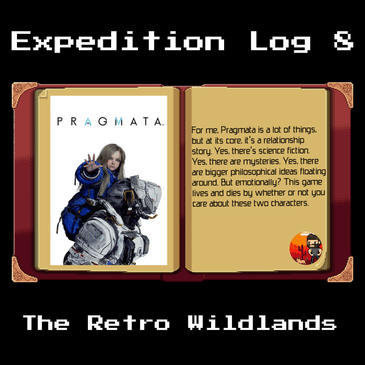
I wasn't expecting Pragmata to hit me this hard. What started as a sci-fi adventure on the moon became one of the most emotional gaming experiences I've had in years. As a step-father, Hugh and Diana's relationship resonated with me in ways I never saw coming. And yes... my wife caught me crying at the end.
In this episode of The Retro Wildlands, I head to the moon to discuss Capcom's ambitious new adventure, exploring its haunting atmosphere, stunning presentation, unique combat system, and the relationship between Hugh and Diana that serves as the heart of the experience. While the game isn't without flaws, including combat that can become repetitive in its later hours, its emotional storytelling and unforgettable character moments left a lasting impression on me.
Intro - 0:00
Pragmata - 4:17
Closing Gratitude - 32:25
Check out our website!
https://theretrowildlands.com/
The Retro Wildlands is part of the SuperPod Network of gaming podcasts and content! Check us out!
https://superpodnetwork.com/
Join the SuperPod Lounge Discord Server!
https://discord.com/invite/7zXbMvVQks
Follow the Retro Wildlands on Social Media!
Linktree: https://linktr.ee/retrowildlands
Check out the Retro Wildlands on YouTube!
https://www.youtube.com/@retrowildlands
Check out the Michigan Retro Game Expo!
https://www.mrgexpo.com/
[00:00:12] Greetings fellow travelers, vagrants, explorers, wildlanders, and welcome to The Retro Wildlands. My name is Nomad and this is my gaming podcast where I like to share my thoughts and experiences with a video game that I've discovered or rediscovered while roaming the gaming wildlands. Thank you for joining us around the campfire my friends. Over multiple expeditions into the
[00:00:38] wildlands I've had the pleasure of experiencing games of all types. Some games are built around overcoming a challenge, others are built around fostering a community of like-minded people, but sometimes there's just a game that connects with you in an emotional way. Books can do this as well as movies, but there's something incredible about a video game, something that requires your direct involvement, input, and attention. The most memorable games for me
[00:01:08] personally are ones that connect with me emotionally in a way that completely bypasses the analytical part of my brain. These are the types of games that get under your skin. They stay with you after the credits roll. They remind you of people that you love. They remind you of moments in your own life. That is what Pragmata did for me. The older I get, the more I appreciate
[00:01:35] games that are willing to swing for something emotional instead of just trying to be mechanically addictive. I especially appreciate games that find a way to do both, even if it's just for a little while during the experience. Pragmata's story isn't anything groundbreaking, but its simplicity and willingness to just focus on raw emotions and pure innocence make it a breath of fresh air when I think of
[00:01:58] other similar works. And its gameplay, while novel and pretty enjoyable for a time, doesn't rewrite the rules or anything. It all works together in a way that leaves the player with a satisfying experience and doesn't force you to have to think deeply about the plot or how many countless branches of discussion could be had. This is a game about a genuinely good, average man thrust into a situation
[00:02:25] well outside of his control, who forms a paternal bond that shapes him into the hero he needs to be and the father figure he never thought he would become. I am excited to get into Pragmata today, but before we do, a quick one-minute detour. I am so stoked to be a featured guest at the Michigan Retro Game Expo happening August 9th in Kalamazoo, Michigan this year. It's shaping up to be a great event, and I wanted to give the show a shout-out,
[00:02:54] with a message from Retro Game content creator, John Riggs. How are you feeling? You got John Riggs here, and I'd love to see you at the Michigan Retro Game Expo powered by Game Pond. It's happening Saturday, August 29th at the Delta Hotels Kalamazoo Conference Center in Kalamazoo, Michigan. Shop from over 70 vendor tables full of video games and video game-related items. Sign up to compete in gaming tournaments. Attend workshops and panels featuring celebrity YouTube guests and so much more. It's the Michigan Retro Game Expo powered by Game Pond on Saturday, August 29th
[00:03:23] in Kalamazoo. For more information and to get your VIP tickets, go to MRG Expo.com. That's MRG Expo.com. Awesome. Thanks, John. And thank you for indulging me, my friends. I'm hoping I get a chance to see and meet a few of you at the show. Now, before we really get into Pragmata, I do want to say that this episode will remain mostly spoiler-free. I'm going to discuss the setup, the gameplay systems,
[00:03:50] the emotional themes, and some moments that impacted me personally, but I'm going to avoid ruining major story revelations or the ending. I will be sharing audio from some of my favorite parts of the game in order to accentuate a point, or maybe I personally thought it was a good moment. So, in case you want to go into Pragmata completely blind, be mindful as we journey to the moon today.
[00:04:38] I remember several years ago, six-ish years ago to be exact, Capcom announced its first new original
[00:05:33] franchise in almost a decade. Pragmata. Or is it pronounced Pragmata? Whatever. A new development staff was hard at work on this new project, and at the time, we knew very little about it. While I've personally been a huge fan of Capcom over many years, I'll admit that I wasn't really paying attention to this one. On occasion, I would get wind of this game's development, but the whole
[00:05:59] project flew right by me. Outside of the curious little girl who appeared in development trailers, I didn't know anything about the game worth paying attention to. But last year, when development was near completion and we really got to see what this game was all about, I knew I wanted to experience this game. It wasn't the incredible visuals or the sci-fi action that we saw that drew me in,
[00:06:25] though all of that did look very good. It was the idea that the little girl I saw earlier would be someone who both helped me in combat and was someone that I had to look after. It's kind of funny when I think back on it. The idea of being what I try to be in my own life now appealed to me more than I ever thought it would. A protector, a father figure, and an overall good person.
[00:06:52] And I especially knew that there was going to be some special relationship between the two main characters that were featured, and I was very interested in figuring out what that was and experiencing it for myself. Those are the things that ultimately drew me to Pragmata. Beyond wanting to experience those feelings in video game form, my hunger for meaningful experiences through video
[00:07:15] games drove me to grab Pragmata the day it launched. Once I completed my experience from start to absolute finish, I felt like Pragmata did exactly what I was hoping it would, and I still find myself smiling when I think about every single part of my journey. Pragmata's story follows Hugh Williams, an engineer who travels with his team of close friends to The Cradle, a lunar colony that was constructed on the moon.
[00:07:45] Contact with The Cradle has been lost so it's up to Hugh and his team to assess the situation. Pretty standard fare, gotta get the main characters to the location so communication blackout is always the sure bet. When Hugh and company arrive at The Cradle, all seems quiet at first. We learn that the Delphi Corporation has revolutionized manufacturing with their invention called
[00:08:09] the Limb Replicator, a device that can 3D print anything you can think of by using a special material called Luna Filament. The Cradle was mainly established to mine this material and the entire colony is overseen by an artificial intelligence known as the Intelligent Direction Unification System, or EDIS. All across The Cradle are hundreds of different robots controlled by EDIS that carry out
[00:08:38] much of the day-to-day work. It's all a pretty efficient system, but one thing Hugh and company noticed right away is the lack of any human activity. Something was clearly amiss, and while Hugh and company try to work out what's going on, a moonquake rippled across the landscape, destroying portions of the Cradle and separating Hugh from his team. Hugh takes immense damage to himself and his protective
[00:09:03] suit during the Quake, though he's saved by the most unlikely of things… a childlike android who has the ability to hack systems and other robots. The android patches Hugh up and the pair make their way to safety as several moonquake aftershocks ripple through the area and, for reasons unknown, the Cradle's robot
[00:09:26] workers have become hostile. In a matter of minutes, things went from bad to worse and there's almost no making sense of it. Once Hugh makes it to safety, he decides it's time to learn a little bit more about his new companion.
[00:09:54] Your turn. Just… what are you? I am DI-03367, a state-of-the-art pragmatic created here at the Cradle. I possess basic life-saving protocols… Okay, okay, that's enough. I don't need the user's manual. All right, next question. What the hell is going on here? And why are these things trying to kill us? I don't know.
[00:10:22] State-of-the-art, huh? Can't believe they're all gone. I guess I'm on my own now. Hey, uh, DI… I am DI-03367, a state-of-the-art pragmatic created… Whoa, whoa, whoa, hang on a second. Don't you have a name or something? I said I am DI-0…
[00:10:51] Okay, okay. How about we call you Diana? Diana? Yeah. From now on, you can be Diana. How's that fit? Diana. I'm Hugh. I don't do babysitting, but I'm gonna need your help and uh… I- Hugh. Diana. Yeah? Hugh. Diana.
[00:12:02] Unless you're making it a point to keep yourself as stoic as possible, it's hard not to smile a little as this child android embraces her new name, Diana. It's pretty clear that there's something special about Diana, and I don't just mean her personality. But half the fun is figuring out what it all means as you go.
[00:12:26] I don't know if you're just gonna be a little bit more and I'll be the only one of the things that I'm going to say. I'm sure I'm not sure I'm going to be the only one of the things that I'm going to go to the
[00:12:53] On one hand, you've got this massive futuristic mystery involving AI systems, lunar colonization, and humanity pushing technology beyond ethical limits. But on the other hand, the game keeps grounding itself through the relationship between Hugh and Diana. That balance is really what gives the game its identity. Because despite all of the big sci-fi ideas floating around in the background and the very on-the-nose commentary about AI in general,
[00:13:22] Pragmata never loses sight of the human side of the story. Can I give you something? Hugh, thanks for talking to me all the time. Is this supposed to be when we first boarded the tram? Look at that. You wrote your name, too.
[00:13:52] Not half bad, kiddo. Yeah! Can you dribble?
[00:14:20] Now, let's shift gears and talk about the other thing that Pragmata is pretty well known for, and that's the gameplay. For starters, the core combat system revolves around this dual-character mechanic where Hugh handles the physical combat using a wide variety of firearms while Diana assists through hacking systems. It sounds very chaotic and almost a little too much to wrap your head around, but I absolutely loved the concept.
[00:14:49] When it came to the actual combat, I got used to it much quicker than I was expecting. I'm going to try and keep it simple, but combat largely works like this. It all revolves around the partnership between Hugh and Diana, and unlike most third-person action games, simply aiming and shooting is not going to be enough. While Hugh handles movement, dodging, and firing weapons, Diana is going to support him by hacking enemy defenses in real time.
[00:15:18] Now, I say Diana supports him, but it's really you as the player that is controlling both Hugh and Diana together. When it comes to Diana's hacking, before enemies can take significant damage, players must quickly navigate a small hacking grid that appears on screen, moving a cursor through various nodes to weaken or disable an enemy's armor, and then expose their vulnerabilities. Once the hack is successful, Hugh can unload on the target while it's vulnerable.
[00:15:47] I know, it sounds complicated, but imagine moving Hugh around like you normally would in a third-person shooter. When it comes to the hacking mechanic, all you do is aim at your target, and then using the controller's face buttons, like X, Circle, and Triangle on the PS5, you move your cursor through the maze of nodes to an endpoint. Once you reach that endpoint, bam, hack successful, and it's time to unload your weapons.
[00:16:15] I love how unique this idea is, and what makes the system interesting is that you're effectively multitasking throughout every encounter. You're managing positioning and enemy attacks with Hugh while simultaneously solving a brief puzzle with Diana. Early in the game, this creates a unique rhythm that feels very different from a traditional shooter. Instead of simply reacting to enemies, you're constantly balancing offense, defense, and problem solving.
[00:16:44] This is especially true when there's more than one enemy on screen. It's especially truer when you have different types of enemies on screen all at once. It all gives combat a more strategic feel and reinforces the story's central idea that Hugh and Diana are much stronger together than they are apart. As you defeat enemies, they'll drop Lunafilament that you can use to upgrade a pretty vast collection of firearms and abilities for Hugh,
[00:17:14] and a decent amount of hacking upgrades and abilities for Diana. Combat was always worth it, just to gain a little extra Lunafilament, as upgrading your gear gives you a much-needed edge. As the game progresses, new enemy types and hacking challenges add variety to the formula, although the basic loop of combat starts to feel a little repetitive during the later chapters, even with all the new challenges.
[00:17:40] What kept me engaged was knowing that every combat encounter would get me a little bit more Lunafilament so I could use it to upgrade my stuff, but the repetition did start to wear on me after a bit. Whether you love it or not, Pragmata's Combat isn't just another cover-based shooter. It's a mechanic built around cooperation between its two main characters, which helps tie the gameplay directly into the game's themes of trust, relationship, and connection. It may not feel that way at first,
[00:18:10] but it'll make more sense as your bond with Diana grows, and you realize when push comes to shove, you, the player, will do anything you can to protect her. Did you hear that? Oh, getting close to snack time. Do humans really need to eat more than once a day? Your energy efficiency doesn't seem good. Sure, that's fair.
[00:18:37] But sharing a meal is more than just recharging. I was an orphan, so at dinner with my new family, just having someone that'd listen was magical. It was all kid stuff, but they were always there. Talking with someone who just accepts you for you is a kind of nourishment, but for your soul. You can get nutrients from talking? Something like that.
[00:19:16] While the game's combat is certainly a focal point, it's worth emphasizing that Pragmata isn't a game that's constantly pushing the player from one firefight to the next. A significant portion of the experience is spent exploring the lunar facility, solving environmental puzzles, traversing damaged sections of the station, and uncovering pieces of the story through observation and through the many files and documents you find. The game often slows its pace intentionally,
[00:19:44] giving players time to absorb the environment and reflect on what they've learned. There are stretches where the greatest reward isn't a new weapon or ability, but simply discovering another clue about the station's fate or spending a few more minutes with Hugh and Diana as their relationship develops through some fun and interesting real-time conversations. For me personally, I thought the game's story and the way things unfolded, at least in the beginning, was a little slower for my take,
[00:20:12] but everything was supplemented by the environment itself and when Hugh and Diana were learning about each other through some fun dialogue. It all has purpose, and I promise you, the payoff is worth it. Speaking of atmosphere, Pragmata's amazing atmosphere makes exploring the world enjoyable and remarkable. The lunar setting feels simultaneously futuristic and abandoned, if that's even the right word,
[00:20:40] creating an almost haunting loneliness throughout much of the adventure. Whether you're moving through sterile research corridors, gazing out at the vast emptiness of space, or navigating areas where technology has clearly gone wrong, there's a constant feeling that you're walking through the aftermath of something significant. The game trusts players to take in these details for themselves rather than stopping every few minutes for lengthy exposition,
[00:21:07] which helps the world feel more authentic and lived in. I can't count how many times I would find myself just looking around in awe at the environment. Everything is made with that in-game 3D printing technology, and you can see how well that works, and especially how well it doesn't work in believable ways. Looking closer at the actual visuals, Pragmata is very impressive.
[00:21:34] Capcom's RE engine continues to be an absolute powerhouse, delivering stunning environmental detail, realistic lighting, and some truly beautiful character animations. And it's not hard to notice all the work that Capcom put into Diana's flowing blonde hair. Seriously though, what impressed me most wasn't just the technical fidelity, but how effectively the visuals support the game's emotional tone.
[00:22:01] The cold, metallic surfaces of the station that were just a little too clean, the glow of computer displays and otherwise dark rooms, and the stark contrast between humanity's technology and the emptiness of the moon all contribute to the game's sense of isolation. Then, when the game shifts to quieter, more personal moments between Hugh and Diana, the detailed facial expressions and subtle animations
[00:22:28] help sell emotions that dialogue alone couldn't fully communicate. The highest compliment I can give Pragmata's presentation is that there were numerous moments where I simply stopped moving for a few moments and just took it all in. The game constantly delivers scenes that feel cinematic without sacrificing player control, allowing you to appreciate both the artistry of the world and the story unfolding within it.
[00:22:54] In an era where many big-budget games can sometimes blur together visually, Pragmata manages to establish a distinct identity, one that feels equal-part science fiction spectacle and deeply character-focused.
[00:23:33] Teammates look out for each other. And we're a team, right? Now, even with the strength of its gameplay, presentation, and even the overall story,
[00:24:04] the true heart of Pragmata's experience, without a doubt, is Hugh and Diana. Because without them, I don't think this game works nearly as well. For me, Pragmata is a lot of things, but at its core, I feel like it's a relationship story. Yes, there's the science fiction angle. Yes, there are mysteries to be solved. And yes, there are bigger philosophical ideas floating around. But emotionally,
[00:24:33] this game lives and dies by whether or not you care about these two characters. Thankfully, I absolutely did, and I know a lot of other people who've played this game did as well. From the bits of dialogue in and out of combat to the questions Diana asks Hugh about life on Earth, it was all so genuine and heartfelt. I've seen some people argue that the emotional relationship at the center of Pragmata doesn't carry the same weight
[00:25:02] because Diana isn't human. She's an AI, artificial intelligence. But honestly, that is a perceptive that I struggle to understand. Throughout the story, Diana displays curiosity, compassion, humor, fear, and a desire to connect with others. She learns and grows and forms a meaningful bond with Hugh and with the player by extension. At a certain point, I found myself caring less about what she was made of
[00:25:31] and more about who she was. The game isn't asking us to examine a machine, it's asking us to examine what makes a perfect worthy of empathy and love in the first place. And it's not doing that by putting that concept front and center. It's just giving you, the player, the chance to form a relationship with something. And I think as you do that, you stop thinking about what it is that you're forming a relationship with
[00:26:01] and who you're forming that relationship with. As a stepfather in real life, or IRL, as the kids say, that idea resonated with me in a very personal way. The moments that reminded me of my own relationship with my own stepdaughter had nothing to do with biology, and they certainly didn't have anything to do with whether someone was made of flesh or circuitry. They were about trust, patience,
[00:26:30] shared experiences, and the gradual building of a bond. Those are the things that make relationships meaningful. Diana may be an AI, but the feelings she inspired in me as a player were very real. When I laughed at her curiosity, worried about her safety, or found myself getting emotional during certain moments, those reactions were not diminished because of what she was.
[00:26:58] You've been to the sea before? On Earth? Of course I have. Got a house with a view and everything. A house? We'd head down to the water anytime we felt like taking a break from it all. Ocean breeze does a number on the paint, but... Breeze in the paint?
[00:27:31] It'll make sense when you see it. You know, back on Earth? You're just gonna stay here when this is all done? What do you want? To go to Earth? With you? Can I really go? Mm-hmm.
[00:28:01] Then I can go see your house? And the ocean! And real trees! You bet.
[00:28:29] One thing I keep thinking about after finishing Pragmata was the idea that some imperfect games become more memorable than technically superior ones. And I know that sounds weird. One of the things that drives me crazy about modern gaming today is that we spend so much time online ranking games based on things like frame rates, review scores, how much a game compares to another, mechanics, it goes on. But years later,
[00:28:57] most people don't remember games because they were perfectly optimized. They remember games because they felt something. They remember moments, characters, music, atmosphere, conversations. They remember how a game entered their life at the right time. Pragmata absolutely falls into that category for me. Now, is it a flawless experience? No. Does the combat get repetitive? Sure.
[00:29:28] Could some systems have been deeper? Absolutely. But I connected with this game emotionally in a way that I simply don't with a lot of other modern AAA releases. And when I think about why, I think it's because it just felt sincere. It felt like a game willing to slow down, willing to be quiet, willing to prioritize emotion and atmosphere over nonstop spectacle. Though I will say, when there was spectacle, it was nothing short of incredible.
[00:29:59] I miss games like that sometimes. There are so many games now designed entirely around engagement loops. Things like daily objectives, retention systems, open world bloat is a term I've heard. Pragmata instead felt focused. It felt very personal and dare I say human. Even when it stumbled mechanically, I always respected what it was trying to accomplish.
[00:30:28] And at the end of the day, I had fun. Real, genuine fun. That's what a game is supposed to be, right? So, where do I ultimately land on Pragmata? Well, I think it's pretty clear, but I love this game. Right now, this and Resident Evil Requiem are my frontrunners for my personal game of the year. The atmosphere was incredible. The presentation was beautiful.
[00:30:58] The combat was unique and engaging. The world itself pulled me in immediately, but more importantly, Diana and Hugh completely won me over. Their relationship became the emotional backbone of the entire experience. And as somebody who saw echoes of my own family dynamic inside that relationship, the game hit me on a deeply personal level. These are the experiences I treasure most as a gamer now.
[00:31:28] Not just games that impress me technically, but games that remind me why storytelling in this medium can be so powerful. Even with the repetitive combat, even with some pacing issues here and there, even with some other flaws, Pragmata stayed with me and will stay with me for a long time. And at the end of the day, I think that matters more than perfection.
[00:31:53] And with that,
[00:32:26] we close the book on our eighth entry into the expedition log, my friends. This has been the Retro Wildlands Expedition Log number eight, Pragmata. Thank you very much for tuning into the show today. Before we put out the campfire and head our separate ways, don't forget to give the Retro Wildlands a follow on social media and make sure you subscribe to the show as well. Our website, theretrowildlands.com
[00:32:54] is also the place you want to be for the latest content as well as our growing catalog of podcast episodes and blog entries. You can sign up for a free account on our website, which will allow you the ability to leave comments on pretty much everything, and it's a great way to interact with me, the show, and the community. The Retro Wildlands is also part of the Superpod Network, home of some other awesome video game podcasts and other gaming content, and you can check all of that out and more
[00:33:23] by heading over to superpodnetwork.com. Thank you all again for hanging out with me today. Coming up in our ninth Expedition Log entry, I decided I wanted to try a Retro game in this format. Long-time listeners might remember that I originally started these Expedition Logs as a way to talk about modern games in between all the long-form retro-focused episodes. I've been digging the Expedition Log format lately,
[00:33:50] so I wanted to see if I could do a retro game in the same style, and make it sound fun and entertaining, of course. The question I've been wrestling with is, what would be the right game to test this out on? As I was going through my library of original PlayStation games, I saw it. The perfect game. It's part of a series that was huge at one time, but ultimately vanished. No one seems to talk about it now, which is a shame.
[00:34:19] I, of course, am talking about the one and only Syphon Filter for the original PlayStation. I think it is long past time to go back to that one and see how it holds up today. I have not played this game since I was very, very young, so I am very interested to see what this journey is going to look like. I hope that you can join us again next time, my friend, as we check out a game that made a unique mark on the gaming landscape many years ago,
[00:34:49] only to vanish without a trace. Should be a good time, so I hope to see you again soon when we add another adventure into the gaming wildlands into our logbook. Until then, my friends, my name is Nomad, and you can find me... roaming the retro wildland.