

Every Move Counts
There are certain genres of games I’ve simply accepted aren’t really “for me.” Puzzle games are usually near the top of that list. It’s not that I dislike them outright, but more often than not, I end up feeling like my brain hits a wall long before the game wants me to. I’ll stare at a puzzle for ten minutes, convince myself I’m missing something obvious, and eventually either brute force the solution or quietly move on to something else entirely.
And while I was expecting that out of Hitman GO, I thought maybe it would be different for me. I thought maybe it would be simple enough that I could overcome some challenges and not feel like things were too easy. Thankfully, that was largely my experience.
Somehow, this little turn-based puzzle spin-off took a series known for elaborate assassinations and transformed it into something stripped down, minimalist, and methodical without losing the spirit of Hitman in the process. Even more impressive, it managed to keep me engaged from beginning to end despite puzzle-heavy games rarely holding my attention for long.
And even though this game is on a wide selection of platforms now (console, PC, mobile), playing it on the PlayStation Vita was a fantastic way experience it.

Mission Briefing: What Hitman GO Actually Is
Hitman GO takes Agent 47 and drops him into what essentially feels like a high-end board game. Instead of sneaking through large open environments in real time, every level is built around a grid-like path system where enemies move according to predictable patterns. Every move you make advances time, causing guards to patrol, snipers to aim, or other hazards to activate or deactivate.
Your objective is usually simple; either assassinate a specific target, or reach a designated exit point. All the while, you'll need to contend with various types of enemies patrolling around or guarding specific areas.
The simplicity is what makes it work so well. Levels are short, focused, and easy to understand at a glance. Early puzzles ease you into the mechanics before gradually layering on disguises, distractions, hidden paths, dogs, heavily armed enemies, and more complex enemy interactions. As things get more complicated, the game starts asking you to think several moves ahead like a chess match where every mistake can get Agent 47 eliminated.
What surprised me most was how authentically Hitman it still felt despite the dramatic genre shift. Granted I personally only have one Hitman game under my belt, the DNA is easy to see. At its core, Hitman has always been about observation, patience, timing, and execution. Hitman GO strips away everything else and leaves behind the pure puzzle-solving identity underneath.

Field Operations: Built Perfectly for Portable Play
While available on console or PC, this game feels tailor-made for handheld gaming. The structure of Hitman GO made it incredibly easy to pick up my Vita, clear a few missions, and put it back down without feeling like I needed to dedicate hours at a time to progress. Most levels are bite-sized enough that even failed attempts never felt overly punishing, which made it ideal for quick sessions when I just needed to kill some time.
That pacing became one of the biggest reasons I kept coming back to it. Some games feel awkward on portable systems because they demand long uninterrupted sessions or rely heavily on immersion and cinematic storytelling. Hitman GO goes in the complete opposite direction. Its clean menus, quick level restarts, and compact mission design make it one of those games that naturally slips into a handheld routine.
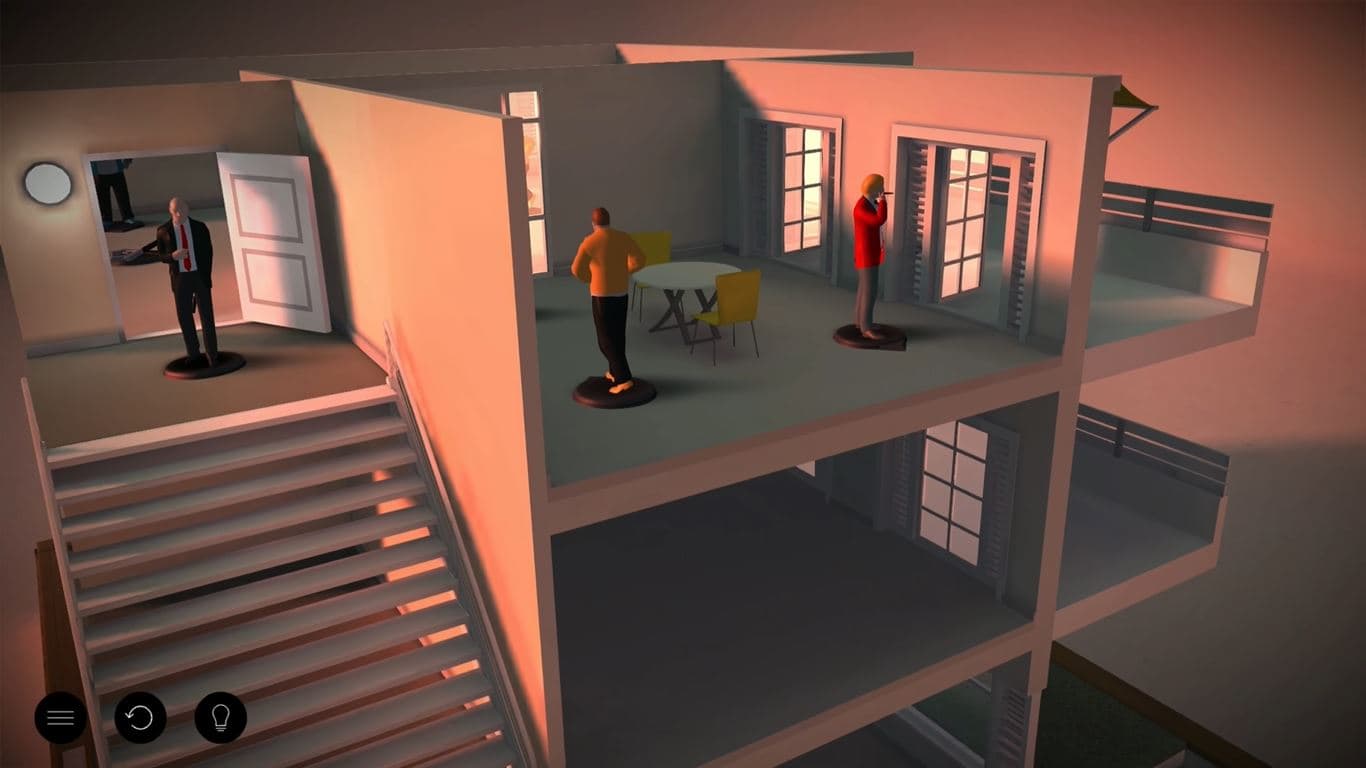
The presentation helps a lot too. The game uses a sleek minimalist art style where every stage resembles a carefully crafted diorama sitting on a tabletop. Characters move like game pieces being slid across a board, and the entire experience has this calm, almost clinical atmosphere to it. It’s stylish without trying too hard, and it gives the game a unique identity compared to other puzzle titles. Even years later, it still looks sharp.
Why the Puzzle Solving Actually Worked for Me
I think the biggest compliment I can give Hitman GO is that it made me want to keep solving puzzles even when I started doubting myself. That may sound small, but for someone who normally bounces off puzzle-centric games, it says a lot.
The game does an excellent job gradually teaching mechanics without overwhelming the player all at once. Early levels build confidence naturally, and before I realized it, I was pulling off elaborate sequences involving distractions, timed movement, enemy manipulation, and coordinated takedowns that would have intimidated me at the start of the game. And when a solution finally clicked, it was genuinely satisfying.
There’s a very specific feeling Hitman GO creates when you stare at a complicated board for several minutes, mentally work through the possibilities, and finally execute the perfect sequence successfully. It taps into the same rewarding feeling as solving a difficult riddle or finally beating a challenging boss encounter. The game consistently made me feel clever without making me feel excluded and that balance is difficult to pull off.

Mission Compromised: The Frustration of the Final Act
After all of that, I have to say, the difficulty curve definitely becomes more aggressive toward the end. The final handful of missions pushed me into full trial-and-error territory. Instead of confidently piecing together a clean solution from observation alone, I often found myself experimenting repeatedly just to understand how certain situations were even meant to function.
To be fair, some of this could absolutely be a “me problem.” Puzzle veterans may breeze through sections that completely stopped me in my tracks. But there were moments where frustration started creeping in because I no longer felt like I was solving puzzles through logic alone. Sometimes it felt more like I was testing possibilities until the game finally let me through.
Oddly enough, I didn’t completely hate that. Even during the rougher puzzles, there was still a strong sense of satisfaction when everything finally came together. The difficulty spikes occasionally tested my patience, but they also made success feel earned. Still, I do think some players may bounce off the later levels if they aren’t already invested.

Moving to Extraction: Final Thoughts
By the time the credits rolled, I found myself surprisingly satisfied with Hitman GO. I do wish there had been more to unlock or additional content waiting after completion because the core gameplay loop was strong enough that I absolutely would have kept playing.
At the same time, there’s something respectable about a game that knows exactly what it wants to be, delivers on that concept, and leaves before overstaying its welcome.
Hitman GO may not have the sprawling freedom of the mainline Hitman games, but it succeeds by focusing on precision, efficiency, and smart design. It transforms the series into something entirely different while still preserving its identity in ways I genuinely didn’t expect.
More importantly, it managed to win over someone who normally struggles to connect with puzzle-heavy experiences. That alone feels like a successful mission.
"Hitman GO" from Hitman GO (Square Enix, 2014). Downloaded via KHInsider. All rights belong to Square Enix.